
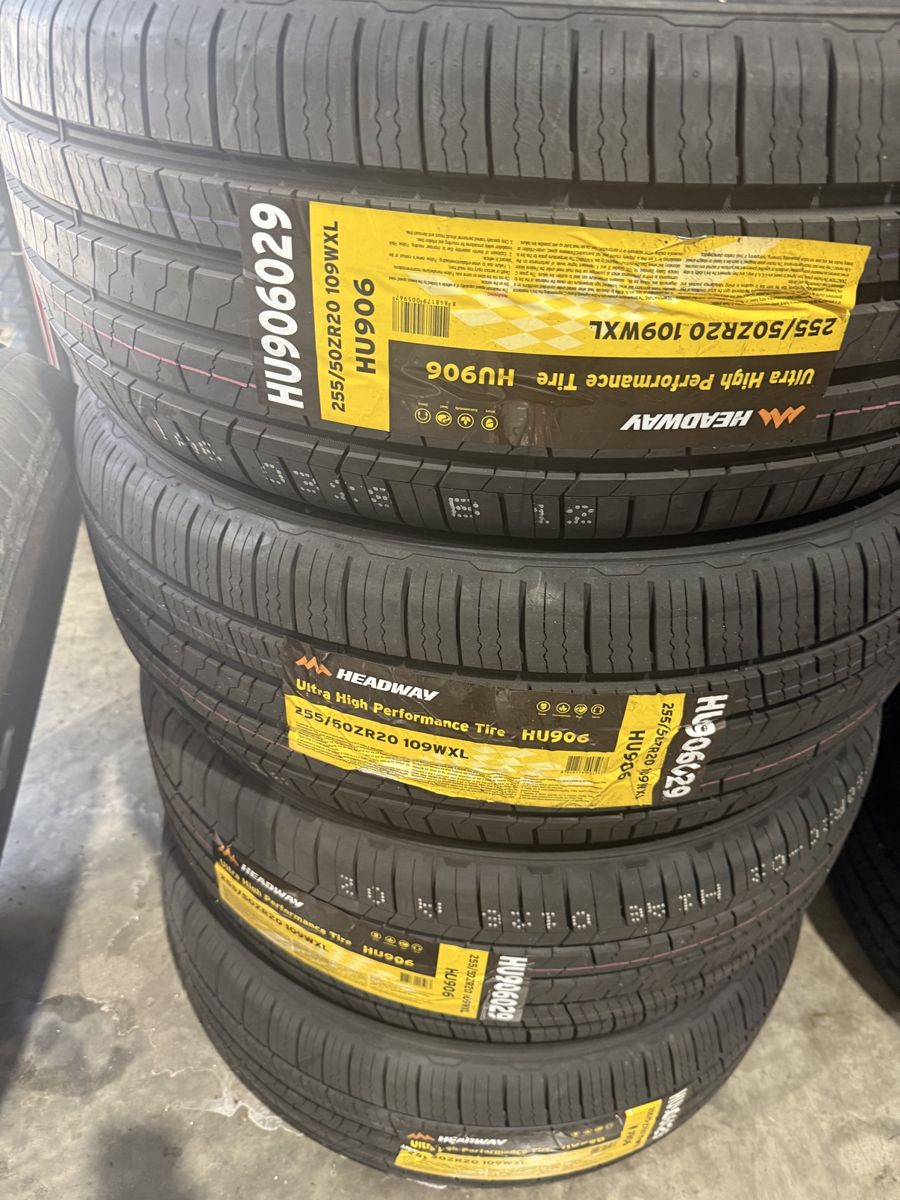
Most drivers know tires are supposed to be rotated. Fewer know the tires do not just trade places at random. There are standard rotation patterns, and which one your vehicle gets depends on which wheels do the driving, whether your tires are directional, and whether the front and rear tires are even the same size. Using the right pattern is what makes a rotation actually even out wear instead of just shuffling it around.
Why the pattern matters at all
Each corner of a vehicle wears a tire differently. Front tires on most vehicles carry the engine's weight and do the steering, so their shoulders take a beating. Drive tires wear faster than tires that only roll along. If every tire stayed in one spot its whole life, the set would wear out at four different speeds, and the worst position would decide when you were buying tires.
Moving tires on a pattern spreads those wear jobs around so all four tires age together. How often that should happen is a separate question — we covered it in our article on how often to rotate your tires. This article is about where each tire goes when the rotation happens.
Front-wheel drive: the forward cross
On a front-wheel drive car or crossover, the front tires do most of the work — driving, steering, and most of the braking. They wear noticeably faster than the rears. The standard pattern is the forward cross: the front tires move straight back, and the rear tires move to the front, crossing sides as they come forward — the left rear goes to the right front, and the right rear goes to the left front.
Crossing the rears as they move up puts them on the opposite shoulder pattern when they take over steering duty, which helps cancel out the feathered wear front tires tend to develop.
Rear-wheel and four-wheel drive: the rearward cross
Trucks and SUVs that drive the rear wheels — or all four — use the mirror image. The rear tires move straight forward, and the front tires move to the rear, crossing sides on the way back. This is the rearward cross, and it is the pattern most of the pickups around Barren County get.
There is also an X pattern, where every tire moves to the opposite corner. Some all-wheel drive vehicles call for it, and it is sometimes used where a wear pattern needs correcting. The owner's manual for the vehicle is the tie-breaker — manufacturers publish the pattern they want, and a good shop follows it rather than improvising.
Directional tires only move front to back
Some tires are built to roll in one direction only. They are marked with an arrow or the word "rotation" on the sidewall, and their tread is designed to push water out as it turns the right way. A directional tire cannot cross sides without being taken off the wheel and flipped, because crossing sides would make it roll backwards against its tread.
So on a vehicle with directional tires, the rotation is simple: front to back and back to front, same side. The tires still trade drive and steering duty, which is where most of the uneven wear comes from.
Staggered setups move side to side
Some cars run wider tires on the rear than the front — a staggered setup. Nothing can move front to back, because the sizes differ. If the tires are not directional, they can at least swap side to side on the same axle, which evens out shoulder wear. If they are directional and staggered, the tires cannot be rotated in the usual sense at all, which is one of the trade-offs of that setup and worth knowing before you buy into it.
The fifth tire: full-size spares
If your truck or SUV carries a full-size spare that matches the other four, it can join the rotation as a fifth tire. Working the spare in spreads wear across five tires instead of four and keeps the spare from quietly aging out in the carrier, never used. A temporary donut spare cannot be part of a rotation — it is an emergency-only tire — and a spare that is a different size or a much older tire should stay a spare.
What we check while they are off
A rotation is also the easiest time to look at things that are hard to see with the wheels on: tread depth at several points, the inside shoulder you cannot see from the curb, brake pads, and any nail or screw that has not started leaking yet. That inspection is half the value of the visit.
At Southern KY Tire Pros, rotations are free with any tire purchase from the shop, and our techs rotate on the pattern your vehicle calls for. If you are not sure which pattern yours takes, that is our job to know. You will find us at 1004 Happy Valley Rd, Glasgow, KY 42141 — call (270) 861-2003 or text (270) 320-7359, Monday–Friday 8:00 AM–5:00 PM. Details are on our Tire Rotation page.