
A steering wheel that shakes is not one problem — it is a symptom with a short list of usual causes, and the details matter. When the shake shows up, how fast you are going, and whether you are braking at the time point in very different directions. Pay attention to those three things before you call, because they are the first questions a good shop will ask, and your answers save diagnostic time.
Shake that arrives at highway speed: start with balance
The classic pattern is a vibration that is not there in town and starts as you get up to highway speed, felt through the steering wheel or the seat. That speed-specific shake is the signature of a wheel that is out of balance. Every tire and wheel has small weight differences, and balancing corrects them so the assembly rolls true. At low speed you may never feel a small imbalance. At highway speed, it announces itself.
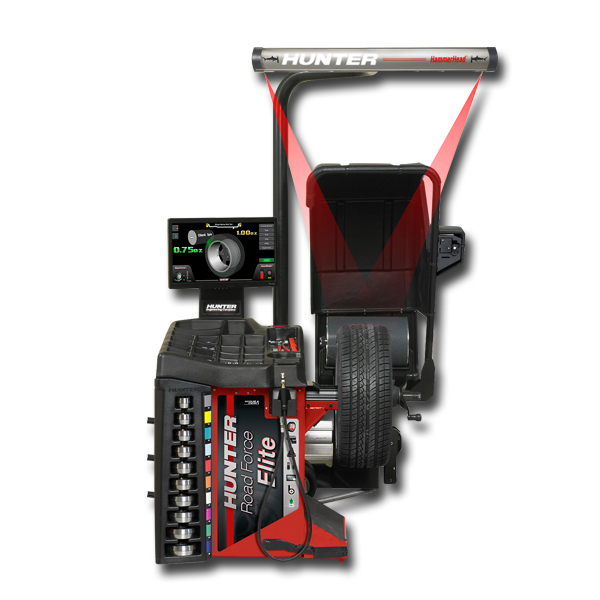
Balancing is not alignment, and the two get mixed up constantly. Balancing is about weight; alignment is about angles. A vehicle can be perfectly balanced and still pull to one side because the angles are off — and the reverse is true too. Our shop balances with a Hunter Road Force Elite balancer, which goes a step further than a standard spin balance: a loaded roller presses against the tire as it turns, measuring how the assembly actually behaves under road force. That catches problems a regular balance can miss, like a tire that is balanced for weight but does not roll round under load.
Shake that only happens when you brake: look at the brakes
If the wheel is steady while you cruise and starts to shake or pulse when you press the brake pedal — especially slowing down from highway speed — the suspect list changes. That pattern usually points at the brake rotors. A rotor that is no longer running true pushes back through the pads and caliper as it turns, and you feel it in the pedal and the wheel at the same time.
The fix is not guessing from the driver's seat. A brake inspection looks at the whole system — pads, rotors, calipers, and fluid — because more than one part can contribute, and replacing only the noisy or obvious part is how a shake comes back a month later. If your shake is a braking shake, our Brake Repair page covers what that whole-system look includes.
Shake with looseness, wandering, or clunks: think front end
A third pattern feels different again: the steering feels loose or vague, the vehicle wanders a little in its lane, there is a clunk over bumps, or the shake comes with tires wearing unevenly. That points toward worn front-end and steering parts — ball joints, tie rods, control arms, and sway bar links are all wear parts, and when they wear, the whole vehicle tells you: it pulls, it wanders, it clunks, and it eats tires.
The evidence is usually sitting on the tires themselves. Cupped tread, one-sided wear, and feathering across the tread each point at a different part of the front end, and reading that pattern comes before quoting any parts. Replacing what is worn — and only what is worn — is the whole discipline. Southern KY Tire Pros is a front-end specialist, and after front-end parts are replaced, the vehicle finishes on our Hunter Hawkeye Elite alignment rack, because front-end work is not complete until the angles are set. Alignments start at $89.99 on most vehicles. Our Front End Repair and Steering & Suspension pages walk through those parts in more detail.
What not to do with a shake
Do not just turn up the radio and live with it. A vibration does not fix itself, and driving on it has a cost beyond comfort: an unbalanced wheel wears its tire unevenly, a braking shake means the brakes are not doing their job evenly, and worn front-end parts work the rest of the suspension harder and wear out the next set of tires early. The shake is also information — the longer it goes, the more wear it adds, and the harder the original cause can be to read.
Also do not assume the cheapest guess is the answer. Balance, brakes, and front-end wear can feel similar from the driver's seat, and they are completely different jobs. The right move is a diagnosis in the right order: note when it happens, check balance and road force, inspect the brakes if braking brings it on, and check the front-end parts for play before anything gets aligned.
Getting it checked in Glasgow
Southern KY Tire Pros is a family-owned repair shop in Glasgow at 1004 Happy Valley Rd, across from Don Franklin on Happy Valley Rd, and our ASE-certified techs track down steering shakes every day. Tell us when yours happens — at speed, under braking, or all the time — and we will trace it to the actual cause before any parts get sold. Walk-ins are welcome. Call (270) 861-2003 or text (270) 320-7359, Monday–Friday 8:00 AM–5:00 PM, closed Saturday and Sunday. See our Road Force Balancing page for how the balance side of the diagnosis works.