
When a shop talks about the front end, it is talking about the group of parts that hold the front wheels in place, let them turn when you steer, and keep them pointed where the steering wheel says. Those parts live under the front of the vehicle, take every pothole and rough road Glasgow and Barren County can hand them, and wear a little at a time. Because the wear is gradual, most drivers adjust to it without noticing, right up until the tires or the steering tell on it.
What is actually in the front end
The main parts are straightforward once they are named:
- Ball joints — pivot points that connect the control arms to the steering knuckle, letting the wheel move up and down and turn at the same time
- Tie rod ends — the links that carry steering input from the rack out to each wheel; play here is play in the steering itself
- Control arms and their bushings — the arms that locate the wheel, with rubber bushings that absorb movement and wear, crack, and soften with age
- Sway bar links — small connecting links that tie the sway bar to the suspension and help control body roll in turns
- Steering components — the rack and its connections, which turn steering wheel movement into wheel movement
Most of these joints are sealed and greased from the factory, and they wear as the grease breaks down and the joint develops slack. Bushings wear differently: the rubber hardens, splits, and stops holding the arm exactly where it belongs.
Symptoms worth paying attention to
Worn front-end parts tend to announce themselves in a few repeatable ways. Clunks or rattles over bumps, railroad tracks, or rough pavement often point to loose ball joints, worn sway bar links, or tired bushings. Steering that feels loose, vague in the center, or that wanders and needs constant small corrections can come from play in tie rod ends or other steering links. Vibration through the steering wheel, pulling to one side, and a wheel that does not return to center cleanly after a turn belong on the list too.
The clearest evidence is often on the tires. Uneven wear, one shoulder scrubbed down, or feathering across the tread means the wheel is not being held at the right angle as it rolls. Tires are, in effect, keeping a written record of what the front end is doing.
Why worn parts eat tires
An alignment sets the angles of the wheels: toe, camber, and caster. Those angles only stay set if the parts holding the wheels are tight. A tie rod end with play lets toe change as the vehicle drives. A worn ball joint or control arm bushing lets camber shift under braking and cornering. The tire then scrubs sideways a small amount with every rotation, and that scrubbing removes rubber fast and unevenly.
That is why replacing tires without checking the front end can be money spent twice. The new tires go onto the same loose parts and start wearing the same way. It is also a safety matter beyond tire wear: a ball joint worn far enough can separate, and that is a breakdown no one wants at road speed.
Why an alignment check follows front-end work
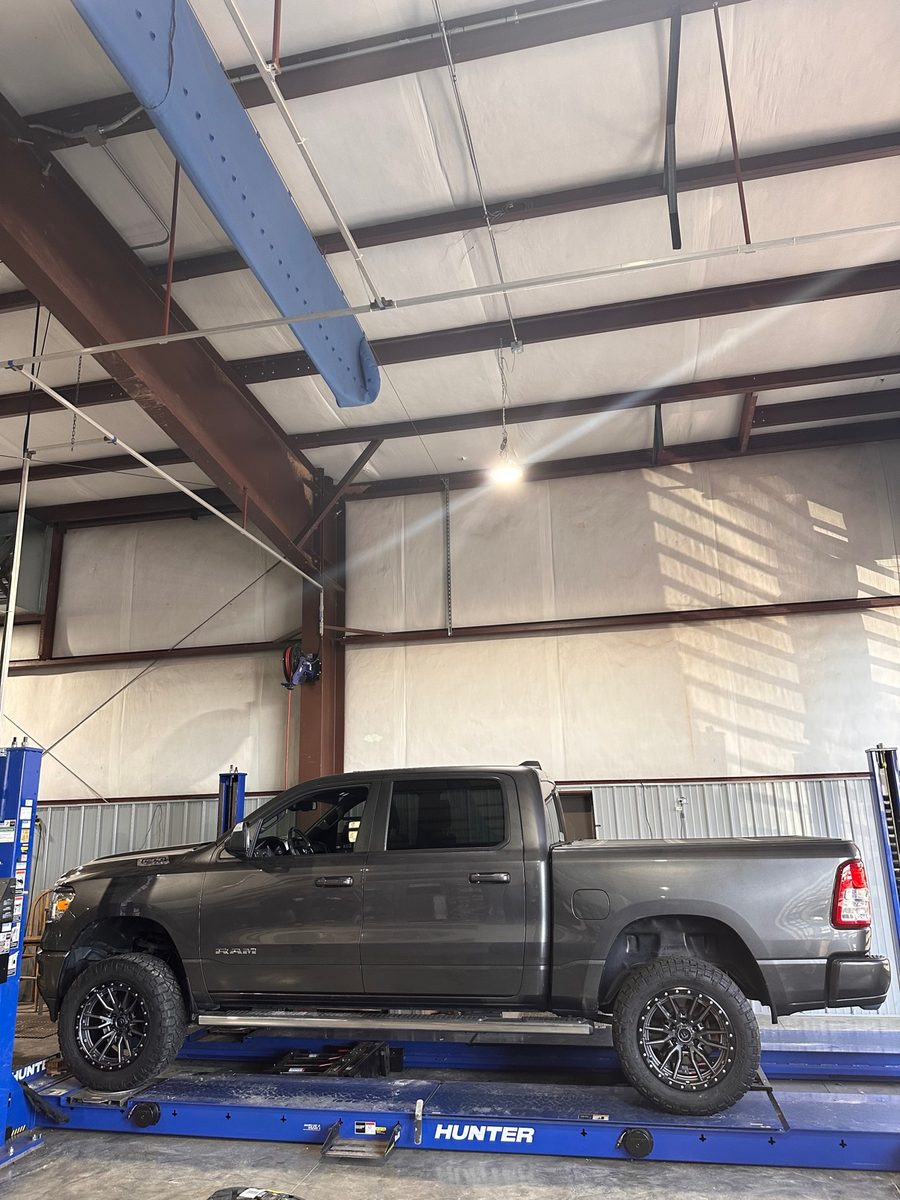
Replacing a tie rod end, ball joint, or control arm changes the geometry those parts were holding, even if the new part is fitted carefully. So front-end repair and alignment go together. The worn part is replaced first, then the angles are measured and set on the alignment machine, in our case a Hunter Hawkeye Elite. Southern KY Tire Pros is a front-end specialist, and that sequence, parts first and alignment second, is the core of the work.
If your vehicle clunks over bumps, wanders, or is wearing front tires unevenly, Southern KY Tire Pros can inspect the front end at 1004 Happy Valley Rd, Glasgow, KY 42141, Monday through Friday, 8:00 AM to 5:00 PM. Call (270) 861-2003 or text (270) 320-7359 to set a time, and walk-ins are welcome. Details are on our Front End Repair page.