
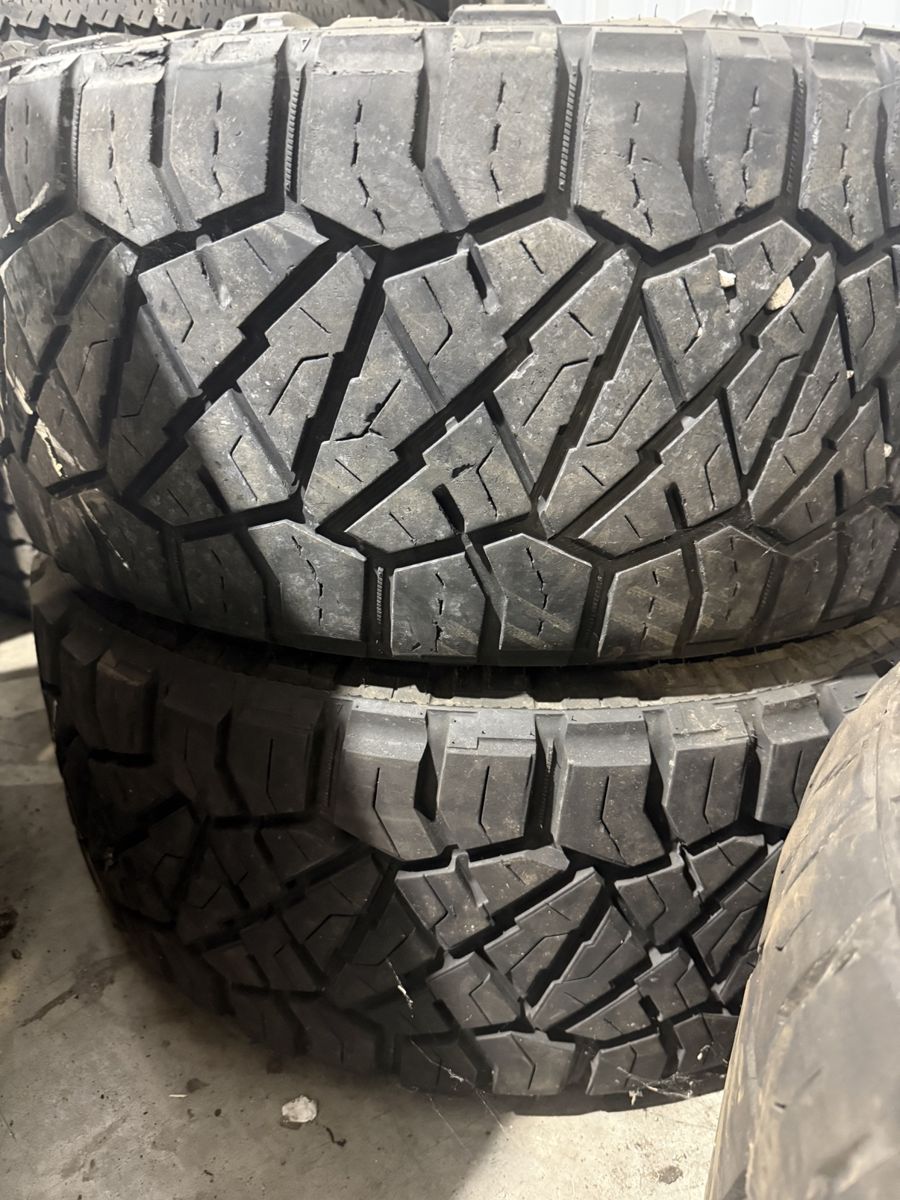
A lot of truck owners in Barren County ask for all-terrain tires because that is what trucks are supposed to have, then spend nearly every mile on pavement between Glasgow, Bowling Green, and Cave City. Others run a highway all-season and then wonder why the truck struggles on a wet gravel drive or getting to a fishing spot after rain. Neither tire is wrong. They are built for different splits of work, and the honest answer starts with how your truck actually spends its week.
What an all-season truck tire is built for
All-season tires for trucks and SUVs — often called highway-terrain — are designed around paved roads. The tread pattern is tighter, with more continuous ribs and finer grooves. That layout is meant to stay quiet at highway speed, clear water on wet pavement, give a smooth ride, and wear evenly over a long service life when the tires are rotated on schedule.
Most all-season truck tires also carry a mud and snow rating and handle cold mornings, rain, and light winter weather in Kentucky reasonably well. What they are not built for is loose surfaces. On wet grass, mud, or loose gravel, the tight tread packs up and has less to grip with, and the sidewalls are generally not reinforced for rocks and ruts.
What an all-terrain tire is built for
An all-terrain tire splits the difference between a highway tire and a dedicated off-road tire. The tread blocks are larger and more widely spaced, with open shoulders that can dig into gravel, dirt, and mud and clean themselves as they turn. Sidewalls are typically tougher, tread compounds are chosen to resist cuts and chips on gravel, and many all-terrains carry the three-peak mountain snowflake symbol for severe snow service.
That construction has a cost on the road, and it is worth naming it directly. Compared with an all-season, a typical all-terrain will make more road noise, especially as it wears. It will often wear a little faster on pavement, and as a rough rule it can trim fuel economy slightly because of its weight and more aggressive tread. Wet-pavement braking and handling are good on modern all-terrains, but the all-season is usually still the more settled tire in day-to-day highway driving.
How Kentucky use actually splits
- Pavement commuting and errands. If the truck is a daily driver that tows occasionally and rarely leaves the blacktop, an all-season covers it well and will be quieter doing it.
- Gravel driveways and lanes. A long gravel drive, a rutted lane, or regular trips across fields when the ground is dry push toward all-terrain. The tougher casing and open tread handle stone and loose surfaces better day after day.
- Hunting and fishing access. Getting in and out of lease land, lake access roads, and field edges after rain is where all-terrains earn their keep. Mud changes the picture, though. Deep mud is a job for a mud-terrain, and no all-terrain should be sold as one.
- Towing and hauling. Either type can be right, as long as the load range and size are correct for the truck and the load. Traction type does not excuse an under-rated tire.
The trade-offs in plain terms
Noise: all-season is quieter, all-terrain hums more, and the gap grows as tires wear. Wear: an all-season driven on pavement will typically last longer; an all-terrain driven mostly on pavement gives up some of that life for grip it rarely uses, while an all-season driven hard on gravel will chip and wear in ways an all-terrain resists. Fuel: expect a small penalty with the heavier, more open tread, not a dramatic one. Ride: all-season is softer over expansion joints and patched roads.
The honest middle answer for most local drivers
For most trucks around Glasgow, the decision comes down to one question: how many miles a month do you truly spend off pavement, and how stuck would you be if the tire could not get you out. If the answer is a gravel drive and the occasional dry field, a modern all-terrain with good road manners is a reasonable middle choice, and it is the pick many local owners land on. If the honest answer is almost never, an all-season will serve you better for less compromise every other day of the year.
We sell more tire brands than we can list, and in most cases we can get the tire you found online for a better price installed, fitted and balanced here. Bring us the size and the model you are looking at and how you use the truck, and we will give you a straight comparison. Visit Southern KY Tire Pros at 1004 Happy Valley Rd, Glasgow, KY 42141, call (270) 861-2003 or text (270) 320-7359, Monday–Friday 8 AM–5 PM. Details are on our Shop Tires page.